
.jpg) 2 hours ago
3
2 hours ago
3
Article content
(Bloomberg) — This month’s surge in Asian bond yields has triggered an increase in debt buying across the region, as governments seek to limit the spillover from higher energy prices to local borrowing costs.

THIS CONTENT IS RESERVED FOR SUBSCRIBERS ONLY
Subscribe now to read the latest news in your city and across Canada.
- Exclusive articles from Barbara Shecter, Joe O'Connor, Gabriel Friedman, and others.
- Daily content from Financial Times, the world's leading global business publication.
- Unlimited online access to read articles from Financial Post, National Post and 15 news sites across Canada with one account.
- National Post ePaper, an electronic replica of the print edition to view on any device, share and comment on.
- Daily puzzles, including the New York Times Crossword.
SUBSCRIBE TO UNLOCK MORE ARTICLES
Subscribe now to read the latest news in your city and across Canada.
- Exclusive articles from Barbara Shecter, Joe O'Connor, Gabriel Friedman and others.
- Daily content from Financial Times, the world's leading global business publication.
- Unlimited online access to read articles from Financial Post, National Post and 15 news sites across Canada with one account.
- National Post ePaper, an electronic replica of the print edition to view on any device, share and comment on.
- Daily puzzles, including the New York Times Crossword.
REGISTER / SIGN IN TO UNLOCK MORE ARTICLES
Create an account or sign in to continue with your reading experience.
- Access articles from across Canada with one account.
- Share your thoughts and join the conversation in the comments.
- Enjoy additional articles per month.
- Get email updates from your favourite authors.
THIS ARTICLE IS FREE TO READ REGISTER TO UNLOCK.
Create an account or sign in to continue with your reading experience.
- Access articles from across Canada with one account
- Share your thoughts and join the conversation in the comments
- Enjoy additional articles per month
- Get email updates from your favourite authors
Sign In or Create an Account
or
Article content
Governments and central banks from South Korea to India and Indonesia are plowing funds into their bond markets to try to cap yields that have already risen to multi-year highs. Yields have been climbing on concern local economies will suffer from higher oil costs as they are net energy importers.
Article content
Article content
Article content
Korea’s government announced last week it would buy a combined 5 trillion won ($3.3 billion) of sovereign bonds over two trading days, while the Reserve Bank of India said it’s purchasing 1 trillion rupees ($10.6 billion) of debt from the open market this month. Bank Indonesia has signaled continued intervention in government bonds.
Article content
By signing up you consent to receive the above newsletter from Postmedia Network Inc.
Article content
“Official bond purchases are better seen as efforts to limit disorderly moves,” as markets price in more persistent spillovers from higher oil prices and supply chain disruptions, said Fesa Wibawa, an investment manager at Aberdeen in Singapore.
Article content
“We wouldn’t rule out further interventions across Asia, especially if pockets of market stress emerge and the authorities judge that they have sufficient policy space to respond,” he said.
Article content
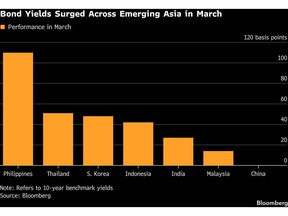
Bond yields have been marching higher across the region as the outbreak of the Iran war on Feb. 28 sent oil prices soaring. The Philippine 10-year yield has surged more than one percentage point in March, while Korea’s has risen by almost 50 basis points and Indonesia’s has climbed more than 40 basis points.
Article content
Article content
In addition to its emergency bond buyback, the Korean government also announced plans to redeem outstanding debt using surplus tax revenues. That followed the Bank of Korea’s decision earlier this month to purchase up to 3 trillion won of treasury bonds to counter increased yield volatility.
Article content
The Korean government’s measures “will be effective in stabilizing the won rates market sentiment” ahead of the inclusion of the nation’s bonds into a major global debt index effective from April, Citigroup Inc. economist Kim Jin-Wook wrote in a research note last week.
Article content
Intervention ‘Needed’
Article content
Bank Indonesia’s market interventions are nothing new. Since the Covid pandemic, the central bank has boosted the proportion of government bonds it owns to around 25% of the total amount outstanding, up from just 10% at the start of 2020.
Article content
“The pace of increase in Indonesia government bond yields has reached levels where some form of intervention is needed to prevent a broader sentiment spillover,” said Winson Phoon, head of fixed‑income research at Maybank Securities. As foreign funds have been net sellers, “intervention would provide breathing space and help maintain orderly market functioning,” he said.
 English (US)