
I discovered magical realism when I was sixteen, the same summer I began a correspondence with my Colombian father. Up to that point, I had lived entirely removed from my birthplace in Colombia. It was the 1980s and I was growing up in the bubble of my single mother’s family, going to school in the mainly white suburbs surrounding the Twin Cities, and spending summers at my white American grandparents’ isolated cabin in the northern woods of Minnesota. This world couldn’t have been more distant from my father and my origins in South America.
Article continues after advertisement
By the time I was in high school, all I knew about him was that he lived far away and was an artist; all I knew about Colombia came from the terrifying news stories of kidnappings and guerrillas in the early 1990s, when it was the most dangerous country on earth. I compared these facts with the grainy photos I found in my mother’s albums. There were pastoral hills and forests, but the Kodachrome green leaves and blue skies had yellowed with time. There were pictures of my mother (so young) and my father (so foreign), both smiling broadly but inscrutably. I remember examining his face—the crinkled eyes, the black mustache—looking to see what part of him I had inherited.
Magical realism allowed writers to capture truth—truth as they understood it.
It was amid this confusion, with a bit of teenage angst, that I wrote “Dear Dad” for the first time. I remember furtively affixing the extra stamps, slipping in a white-edged high school picture, and dropping the envelope in the mailbox, having no way to know how or if it would make its way to my father.
He and my mother met when she was a university student in Colombia in the 1970s. He was a handsome artist; she was a pretty American. They fell in love—or something like that—and she didn’t return to her home in Minnesota. Instead, they got married and moved from city to town, from rented house to apartment, from Minnesota and back to Colombia, where they had me, their only daughter.
In a setting straight out of a novel, my parents lived at the end of a one-lane bridge in a city in the southwestern Colombian Andes, where there was a courtyard in the half of the house they rented from an old woman. Although I have no memory of it, the photos of me as a baby testified to my time spent toddling in the weedy garden with the huge banana leaves as the backdrop to my infancy. When I was nearly two years old, my mother, exhausted from trying to live as a Colombian wife, took me back to the United States. It was an acrimonious divorce, and I grew up without any contact with my father.
The same forces that propelled me to write to him were also what drew me to Latin American literature. I studied these novels in the same way that I used to study my dad’s face in old photos, searching for something familiar, hoping I would learn something about the place where I was born, and maybe even about who I was.
After a lifetime of classic American and British literature, none of my previous reading experience had prepared me for Isabel Allende’s Of Love and Shadows. My romantic teenage heart was captivated by the raw passion of intrepid journalist Irene Beltrán and dashing photographer Francisco Leal, but I also saw myself in Allende’s Evangelinas, the two daughters switched as infants, destined to live distinct lives determined more by their upbringings than their births. Next I read Laura Esquivel’s Like Water For Chocolate and I could taste the sadness of wedding cake in her words, even though I knew, logically, that emotions didn’t have a flavor and babies weren’t that easily mistaken.
Esquivel and Allende soon gave way to One Hundred Years of Solitude, in which I discovered a family that was even stranger than my own. In the Buendías’ legacy of love and betrayal, loyalty and idealism, there was domestic and political violence, but there was also ice in the middle of the jungle and a sickness that put the whole town to sleep and girls that became witches.
My father’s words…and the novels I was reading of food and family, love and regret seemed to come alive around me.
Magical realism is often mistaken for a genre or a subtype of fantasy, but it is neither of those. This literary tool adds elements of the fantastical in otherwise ordinary, realistic settings. My artist father told me that magical realism emerged from the visual tradition of post-World World II surrealism. Then writers, too, began to play with the idea of mixing the ordinary and imaginary, applying it in literature in a blend of politics, history, social justice, and art, and using the tool to push back against oppressive governments or strict social norms.
Throughout the twentieth century, these chiefly Latin and South American writers such as Allende and García Márquez, Pablo Neruda and Jorge Luis Borges employed magical realism in overt and subversive ways, playing with both reality and fantasy. Magical realism allowed writers to capture truth—truth as they understood it.
*
The first thin blue airmail envelope arrived in my suburban mailbox as I was reading Allende’s House of the Spirits, and by the next exchange, I had begun Gabo’s Love in the Time of Cholera and then back to Allende for Eva Luna. As letters between my father and me went back and forth across the three thousand miles that had separated us for my entire life, my father’s words—the phrases and sentences and paragraphs meant to replace a childhood—and the novels I was reading of food and family, love and regret seemed to come alive around me.
In my imagination, the courtyard in the fictional house of the Buendías became the gardens in which I had played as a toddler. The creaking floors of the Truebas’ spirit house were the same wide boards I had crawled on in our house at the end of a one-lane bridge. Truth as I understood it.
Eventually our epistolary relationship moved beyond airmail envelopes, and I traveled to Colombia in my early twenties. I prepared for my visit by rereading those novels in which death and birth are dots on an endless loop, the terrifying to become harmless, and the ordinary—like fathers and daughters—was turned into magic. Later, when I began to write my own stories, elements of magical realism seeped into my writing, an echo of both my voracious reading and my lived experience. I had found a way to understand the truth—or a truth—about who I was and where I came from.
And when my father and I did meet, the wilderness surrounding the airport hummed like the jungle of Macondo, and our eyes crinkled in the same way as we embraced.
_______________________________
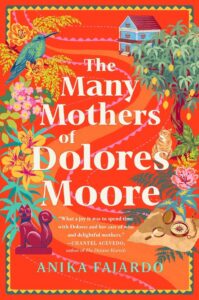
The Many Mothers of Dolores Moore by Anika Fajardo is available from Gallery Books, an imprint of Simon & Schuster.


