
.jpg) 1 hour ago
4
1 hour ago
4
Article content
(Bloomberg) — A wave of Middle Eastern crude is making its way to US shores, offering some respite to a market squeezed by wartime demand for American exports.

THIS CONTENT IS RESERVED FOR SUBSCRIBERS ONLY
Subscribe now to read the latest news in your city and across Canada.
- Exclusive articles from Barbara Shecter, Joe O'Connor, Gabriel Friedman, and others.
- Daily content from Financial Times, the world's leading global business publication.
- Unlimited online access to read articles from Financial Post, National Post and 15 news sites across Canada with one account.
- National Post ePaper, an electronic replica of the print edition to view on any device, share and comment on.
- Daily puzzles, including the New York Times Crossword.
SUBSCRIBE TO UNLOCK MORE ARTICLES
Subscribe now to read the latest news in your city and across Canada.
- Exclusive articles from Barbara Shecter, Joe O'Connor, Gabriel Friedman and others.
- Daily content from Financial Times, the world's leading global business publication.
- Unlimited online access to read articles from Financial Post, National Post and 15 news sites across Canada with one account.
- National Post ePaper, an electronic replica of the print edition to view on any device, share and comment on.
- Daily puzzles, including the New York Times Crossword.
REGISTER / SIGN IN TO UNLOCK MORE ARTICLES
Create an account or sign in to continue with your reading experience.
- Access articles from across Canada with one account.
- Share your thoughts and join the conversation in the comments.
- Enjoy additional articles per month.
- Get email updates from your favourite authors.
THIS ARTICLE IS FREE TO READ REGISTER TO UNLOCK.
Create an account or sign in to continue with your reading experience.
- Access articles from across Canada with one account
- Share your thoughts and join the conversation in the comments
- Enjoy additional articles per month
- Get email updates from your favourite authors
Sign In or Create an Account
or
Article content
At least 9 million barrels from the region are set to arrive at US ports throughout August, data from maritime intelligence firm Kpler show. That’s a big spike, but still only about half of the average level from before the start of the conflict.
Article content
Article content
Article content
The influx includes barrels released after the US and Iran agreed to a now collapsed ceasefire in June, allowing supplies to gush through the Strait of Hormuz for several weeks. They are also made up of shipments from the so-called shuttle-trade, which has helped Middle Eastern producers move barrels through the vital energy chokepoint even as it remained largely blocked.
Article content
By signing up you consent to receive the above newsletter from Postmedia Network Inc.
Article content
The fresh imports come as US commercial crude inventories hover near an eight-year low. The US had been exporting barrels at a breakneck pace in the early months of the Iran conflict to offset disrupted Middle Eastern flows, at one point sending out a record 6 million barrels a day. The influx may help ease pressure on physical markets and keep near-term prices in check, industry participants say.
Article content
The US snapped up whatever supplies it could during the brief ceasefire with Iran, and the oil now headed to the US comes from a range of countries, including the United Arab Emirates and Saudi Arabia. The shipments mark a sharp reversal from last month, when US imports of Saudi Arabian oil dropped to zero for the first time since 1985, as the Iran war hobbled flows and the US sent millions of barrels a day overseas.
Article content
Article content
Of particular note are barrels arriving from Kuwait, which last week arrived on US shores for the first time in six years, according to Kpler and US customs data.
Article content
It’s unclear how long the flows will last given continued threats in the Middle East, while relatively cheap US barrels remain attractive to overseas buyers.
Article content
Some of the Kuwaiti cargoes loaded in the country’s Mina Al-Ahmadi terminal and were transferred to vessels outside Hormuz that then carried them on to the US, according to Kpler and ship tracking data compiled by Bloomberg.
Article content
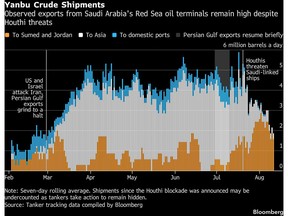
Other cargoes are heading to the US from the Mediterranean, where a growing number of Saudi shipments are beginning their journeys to avoid attacks by Yemen’s Houthi rebels. At least one ship sailed from the Saudi Red Sea port of Yanbu to the US, while others began signaling at the Egyptian port of Sidi Kerir, where ships often pick up barrels that have been transported from the Red Sea.
Article content
The Yanbu cargo may have been passed on by a typical Asian buyer because of the added cost and transit time due to Houthi threats in the Bab el-Mandeb Strait, another key energy chokepoint, according to Matt Smith, Americas lead oil analyst at market intelligence firm Kpler. That has forced Saudi shipments onto longer routes, he said.
Article content
Throughout the war, Yanbu has been one of the industry’s biggest workarounds for the Strait of Hormuz, at times diverting more than four million barrels a day of crude to global markets. The majority of volumes typically head south to Asia, but Houthi activity has imperiled that route.
Article content
There were already signs of rising imports in weekly inventory data this week. US crude inventories rose by 17.4 million barrels last week, the second-largest build ever, after imports surged to the highest since late 2024, according the Energy Information Administration.
Article content
—With assistance from Julian Lee.
Article content
 English (US)