
.jpg) 1 hour ago
1
1 hour ago
1
Article content
(Bloomberg) — Allianz Global Investors is considering purchasing dollars after months betting against the US currency as the war in the Middle East revives its status as a haven asset.

THIS CONTENT IS RESERVED FOR SUBSCRIBERS ONLY
Subscribe now to read the latest news in your city and across Canada.
- Exclusive articles from Barbara Shecter, Joe O'Connor, Gabriel Friedman, and others.
- Daily content from Financial Times, the world's leading global business publication.
- Unlimited online access to read articles from Financial Post, National Post and 15 news sites across Canada with one account.
- National Post ePaper, an electronic replica of the print edition to view on any device, share and comment on.
- Daily puzzles, including the New York Times Crossword.
SUBSCRIBE TO UNLOCK MORE ARTICLES
Subscribe now to read the latest news in your city and across Canada.
- Exclusive articles from Barbara Shecter, Joe O'Connor, Gabriel Friedman and others.
- Daily content from Financial Times, the world's leading global business publication.
- Unlimited online access to read articles from Financial Post, National Post and 15 news sites across Canada with one account.
- National Post ePaper, an electronic replica of the print edition to view on any device, share and comment on.
- Daily puzzles, including the New York Times Crossword.
REGISTER / SIGN IN TO UNLOCK MORE ARTICLES
Create an account or sign in to continue with your reading experience.
- Access articles from across Canada with one account.
- Share your thoughts and join the conversation in the comments.
- Enjoy additional articles per month.
- Get email updates from your favourite authors.
THIS ARTICLE IS FREE TO READ REGISTER TO UNLOCK.
Create an account or sign in to continue with your reading experience.
- Access articles from across Canada with one account
- Share your thoughts and join the conversation in the comments
- Enjoy additional articles per month
- Get email updates from your favourite authors
Sign In or Create an Account
or
Article content
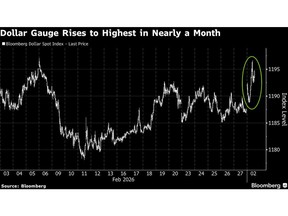
In the short term, there are “good reasons to buy the dollar,” said Greg Hirt, who helps oversee €580 billion ($679 billion) as chief investment officer of multiasset strategies at the European asset manager. The greenback climbed to a three-week high against a basket of currencies on Monday after US President Donald Trump said the bombing campaign against Iran could last for weeks.
Article content
Article content
Article content
“We still believe in the long-term story of de-dollarization, and the slow weakening of the dollar, but perhaps in the short term we may have to go back to a more neutral position,” Hirt said in an interview.
Article content
By signing up you consent to receive the above newsletter from Postmedia Network Inc.
Article content
Hirt’s view marks a shift from roughly a year ago, when Trump’s threats of aggressive tariffs prompted AllianzGI to shift into non-dollar assets, including in Europe and emerging-market nations. But with crude spiking the most in four years, the Iran crisis has turned the traditional correlation between the dollar and oil positive for the first time in three months.
Article content
Read: Dollar Rallies as Oil’s Surge Curbs Bets on Fed Rate Cuts
Article content
Betting against the dollar has become a crowded trade, meaning there’s plenty of potential for a near-term appreciation. The latest CFTC data show that speculative investors trimmed their short positions in the greenback last week, after pushing them to the highest in five years earlier last month.
Article content
Meanwhile, Hirt said he’d turned a “bit more positive” on US Treasuries after they climbed last week when US stocks came under pressure. “I’m not saying we are back to where we were before, but this de-correlation is coming back,” Hirt said.
Article content
A tighter energy market due to the conflict in the Middle East could have an inflationary impact that hits the euro zone and Japan hardest, Hirt said, as both rely heavily on imports to power their economies. That could complicate the outlook for interest rates — particularly the prospect of tightening in Japan, he added.
Article content
 English (US)