
.jpg) 1 hour ago
3
1 hour ago
3
Your birthday tells you how many years you have been alive. But it cannot tell you whether your heart, brain, or kidneys have weathered those years equally well.
That's because organs within the same body can show different levels of biological aging.
A new study published in Nature Medicine suggests that aging leaves different marks on the microscopic structure of each organ.
Scientists have now used those marks to develop a method that may predict which organs look older than expected from a single blood sample.
This is not yet a blood test you can request at a hospital. Nor can it track an organ over many years to directly measure how quickly it is aging. Instead, it estimates whether an organ appears biologically older or younger than expected for a person's chronological age.
A team led by André Rendeiro, with Ernesto Abila, Iva Buljan, and Yimin Zheng as co-first authors, examined 25,712 microscopic tissue images from 983 deceased donors. The samples covered 40 tissue types across 29 organs.
 The authors of the study André Rendeiro, Iva Buljan, Ernesto Abila and Yimin Zheng (from left to right). (Wolfgang Däuble/CeMM)
The researchers trained an artificial intelligence model on tissue samples from people of different ages. Over time, the system learned to recognize subtle structural changes associated with aging, creating a kind of "tissue clock" for each organ.
If the clock judged a 60-year-old person's lung tissue to resemble older tissue, for example, that lung was considered older than expected.
On average, the models' estimates differed from the donors' actual ages by about five years.
The intriguing part was that the estimates appeared to reflect more than a date of birth.
Tissues that looked older than expected tended to show more structural changes and health conditions associated with aging. These included tissue shrinkage, scar-like stiffening, the loss of tiny blood vessels, fat accumulating in skeletal muscle, and thinning nerves.
The body did not follow one universal aging pattern, either. Some people showed signs of advanced aging across many organs. In others, a single organ – such as the heart, lung, or stomach – looked considerably older than the rest of the body.
Directly assessing an organ's biological age, however, usually requires an invasive procedure to collect tissue.
To get around this problem, the researchers matched age estimates derived from tissue images with patterns of gene activity in blood samples from the same donors.
Put simply, they looked for changes in blood gene activity associated with an organ appearing older than expected.
"A blood sample does not directly image the organ; it estimates the organ's age gap through a learned correspondence," André Rendeiro, a principal investigator at CeMM and the Ludwig Boltzmann Institute for Network Medicine at the University of Vienna, told ScienceAlert.
They then developed a second model that estimated how old different organs looked using only blood data. Its predictions were strongest for overall body aging, the digestive system, and the spleen.
To see whether these estimates reflected real illnesses, the researchers tested the method on blood data from healthy people and people with eight different medical conditions. The models generally assigned larger age gaps to organs associated with each condition.
For people who had experienced a stroke, the model assigned the largest age gap to the brain.
In people with Crohn's disease, the esophagus, stomach, small intestine, and colon were assigned larger age gaps.
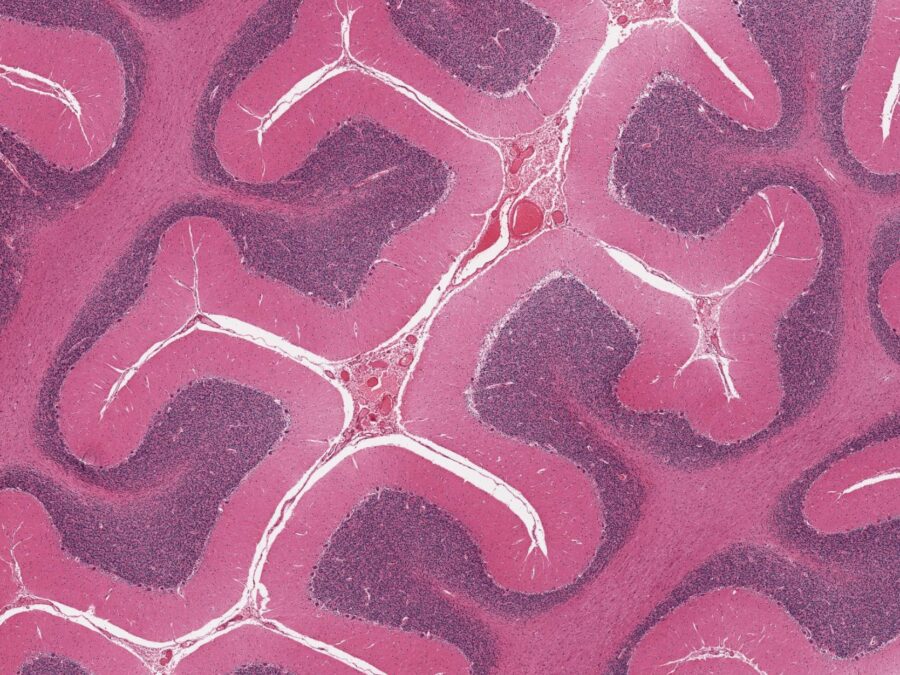 Histological section of a human cerebellum tissue sample used to study age-related changes in tissue architecture. (Wolfgang Däuble/CeMM)
In the Alzheimer's group, the brain was the only organ with a significantly elevated age gap.
These matches suggest that blood may carry clues about what is happening deep inside the body. But an organ looking older does not mean accelerated aging caused the disease. The illness may have aged the organ, or both processes may have developed together.
Earlier blood-based methods have estimated organ age by measuring circulating proteins.
One such study found that having an older-looking brain was associated with a higher risk of death.
However, existing commercial biological-age tests can produce widely differing results.

The new study also has important limitations.
Most of the tissues were collected after death, and the researchers did not follow the same people as they aged. The blood-based method was mainly evaluated in people who had already been diagnosed with a disease.
It remains unknown whether the test could detect illness before symptoms emerge.
Prospective studies, consistent performance across different populations, and regulatory approval would still be required. Reaching clinical use will take "realistically several years, possibly close to a decade," Rendeiro said.
Related: Humans Age Faster at 2 Sharp Peaks, Research Shows
Abila, Iva Buljan, Yimin Zheng, and Rendeiro declared competing financial interests in the form of a patent related to the work.
For now, the study suggests that reducing biological age to a single number may miss an important part of the story.
Your heart, brain, and kidneys may share the same body, but they don't necessarily experience time in the same way.
The study was published in Nature Medicine.
This article was fact-checked by Fiona MacDonald and edited by Fiona MacDonald. While we pride ourselves on our process, we are only human. If you spot a mistake, please let us know.
 English (US)