
.jpg) 1 hour ago
2
1 hour ago
2
A simple calculation may do a better job than body mass index (BMI) at flagging the risk of high blood pressure, according to a new study.
A team from Finland and the US proposes that the waist-to-height ratio (WHtR) is more accurate at predicting people at risk of elevated blood pressure and full hypertension.
While BMI has long been used as a screening tool for overweight and obesity, its accuracy is being questioned. We know that obesity and high blood pressure are closely related, so BMI may be unreliable at predicting the risk of related cardiovascular problems, brought on by excess body fat and hypertension.
"After demonstrating consistent associations across ethnic backgrounds, age categories, and survey cycles, it is safe to conclude that WHtR-based estimates of fat mass provide a more precise and clinically meaningful indicator of hypertension risk," says epidemiologist Mahidere Ali, from the University of Eastern Finland.
"WHtR is a simple, scalable tool that can strengthen early screening and improve detection of adiposity-related cardiovascular risk."
Experts have recently defined three categories for WHtR: normal fat, high fat, and excess fat. Here, the researchers wanted to see if these categories were better at flagging elevated blood pressure and hypertension than BMI.
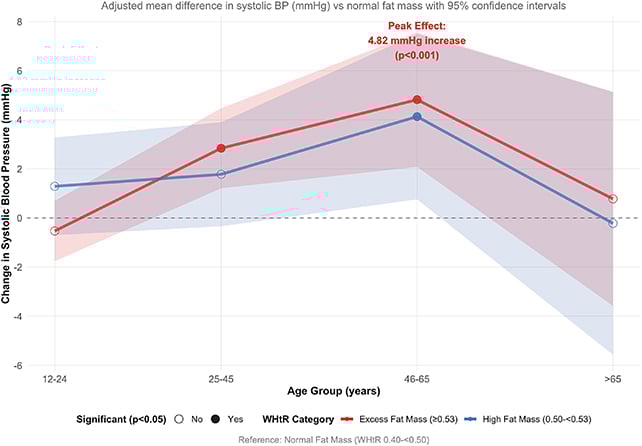 WHtR categories were shown to accurately predict blood pressure. (Ali et al., J. Nutr., 2026)
Based on a data analysis of 19,124 adults and children aged 12 and over, that was indeed the case, particularly when it came to the excess fat category and full hypertension.
Those categorized as having excess fat were 91 percent more likely to have elevated blood pressure (120/70 mm Hg or above in this study), and 161 percent more likely to be hypertensive (140/90 mm Hg or above in this study) than those at the normal level.
For BMI, the relationship was much weaker – those marked as overweight or obese were 71 percent and 130 percent more likely to have elevated blood pressure respectively, but there was no such association for hypertension in the participants with these groupings.
The data analyzed here only shows a snapshot in time, and participants weren't tracked by the researchers. However, the indications are that a simple waist size and height calculation could be a simple, quick way of identifying people likely to have issues with their blood pressure – and that means treatments and changes can be started earlier.

One of the problems with BMI is that it measures weight relative to height without distinguishing between fat mass and muscle mass. That difference matters for a host of health risk reasons, and this is one of the key improvements that WHtR brings.
"BMI failed to detect the independent effect of adiposity, likely because it does not isolate the confounding influence of muscle mass, which may inflate its association with blood pressure at earlier stages while obscuring its relationship with established hypertension," says Ali.
For example, additional fat mass can increase the risk of type 2 diabetes, while additional muscle mass can reduce the risk. Knowing why someone is carrying extra weight matters.
Previous studies have shown that WHtR can work as a way of predicting the risk of type 2 diabetes and fatty liver disease, so even at this stage, it has a strong reputation as a useful medical measure.
Related: A 'Hidden' Metabolic Disorder May Not Show Up on Your Scale, Researchers Say
While BMI remains the standard screening tool for obesity and hypertension for now, there's an online waist-to-height ratio calculator that you can use to work out your own WHtR, based on your age and sex.
"The United States health system is presently burdened by both uncontrolled hypertension and unmanaged obesity," write the researchers in their published paper.
"WHtR is an inexpensive and universally accessible tool that could replace BMI in screening, prevention, diagnosis, and management of obesity and its CVD sequelae."
The research has been published in The Journal of Nutrition.
 English (US)