
.jpg) 2 hours ago
3
2 hours ago
3
When the magnitude 9.0 Tōhoku earthquake struck off the coast of Japan in 2011, its seismic shivers did more than ripple through the planet.
At least one wave traveled 2,900 kilometers (1,800 miles) down to the boundary between Earth's mantle and liquid outer core, where it was reflected right back to the surface.
And there, according to a new analysis of earthquake data from across Japan, it may have done something scientists have never identified before.
GPS observations from the time of the earthquake showed that parts of Japan shifted eastward by up to 5 to 6 millimeters.
The reflected wave, says a team led by seismologist Sunyoung Park of the University of Chicago, may be what gave Japan that eastward nudge.
Quakes are among the most devastating natural disasters our planet can experience, and the Tōhoku earthquake, which generated the tsunami that triggered the Fukushima Daiichi nuclear disaster, was one of the most powerful ever recorded.
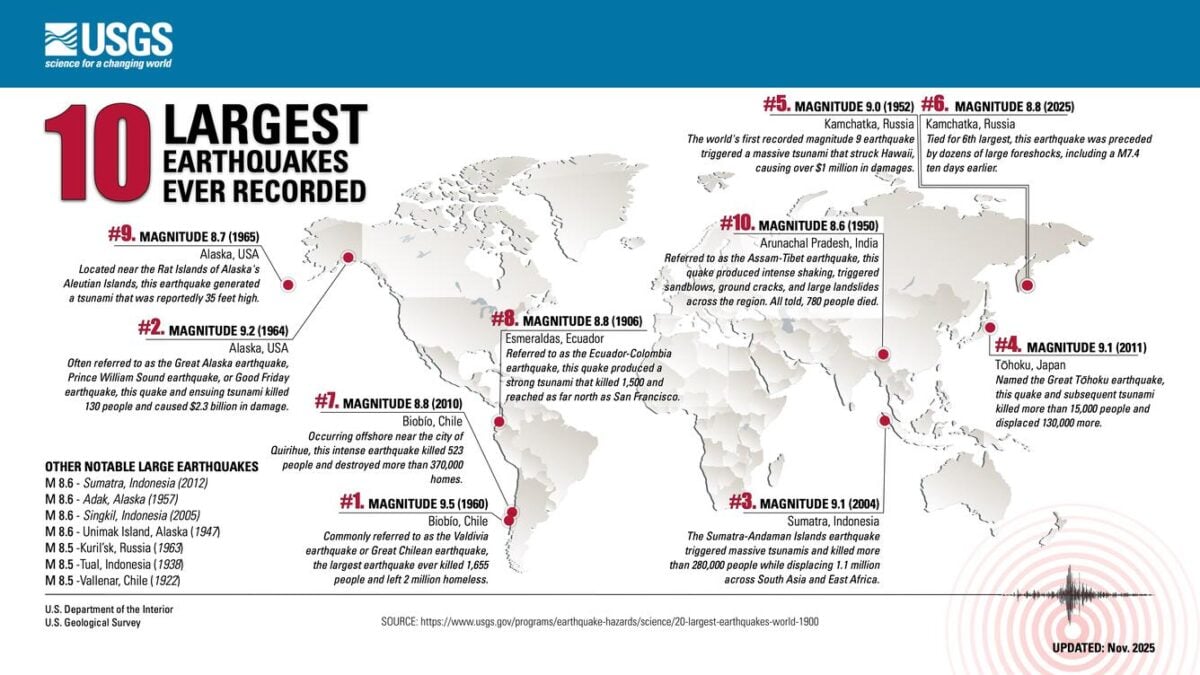 The largest earthquakes in recorded history. (USGS)
It occurred when the Pacific Plate suddenly slipped beneath the plate carrying northern Japan, generating a devastating tsunami and sending seismic waves racing through the planet.
The Tōhoku earthquake remains one of the most closely studied natural disasters in history. Scientists are still combing through the observations it generated, searching for clues about how major earthquakes unfold and what happens in their aftermath.
The event was so enormous that it produced an unusually clear ScS signal in Japan's GNSS Earth Observation Network System (GEONET). That's a designation that means a shear wave (S) that is reflected at the core-mantle boundary (c), and returns as another shear wave (S).
The amplitude of this ScS wave was so large that it was even detectable in China.
That's interesting in itself because GNSS measures ground movement, not seismic waves directly. It's not a traditional seismometer.
So, the researchers were poking around with this signal to see what it could tell us about the quake itself. That's when they noticed something … odd.
After a seismic wave passes through, the ground is expected to return to its starting position. However, the researchers noticed that some GPS stations in Japan appeared to have shifted slightly eastward compared to their starting positions.
The obvious explanation is that it's a glitch – maybe an artifact of data processing.
But when the researchers took this into account and tried to correct for it, the shift persisted, suggesting that it was both real and permanent. Nor could it be readily explained by other possibilities, such as a large underwater landslide or the known mainshock rupture.
What's more, the apparent shift occurred just as the ScS wave arrived back in Japan after its journey to the core-mantle boundary and back.
This suggested to the scientists that they were looking at something new, so they set about modeling to try to identify a process that could reproduce the observed signal.
One of their models fit the observational data better than the others.
In it, the returning shear wave triggered a broad pulse of fault slip at the interface between the two tectonic plates – not a major rupture, but a subtle one across a large area.
Imagine you're pushing two rough surfaces at an angle against each other. Friction will keep them from moving until the point at which force overcomes it, and they suddenly jerk past each other.
That, on a large scale, is what happens at the boundary between two tectonic plates during a megathrust earthquake like the one in Tōhoku, with the edge of one plate lurching beneath its neighbor.
A slip is very similar, except the movement is much smaller. In this case, the researchers infer millimeters-to-centimeters of motion across a vast section of the plate boundary, producing GPS-detectable shifts of just a few millimeters at the surface.
The researchers think the returning wave may have acted like a gentle shove applied to faults that were already under enormous stress from the main Tōhoku earthquake.
Although the ScS wave was far weaker than the original shaking, it arrived across much of Japan at nearly the same time. The team argues that this synchronized pulse may have been enough to trigger a small amount of movement along already-stressed plate boundaries.
The inferred event was surprisingly large in one sense and tiny in another.
The researchers estimate it released about as much total energy as a magnitude 7.5 earthquake.

But instead of occurring as a single rupture, the movement was spread across a vast stretch of plate boundary, resulting in only millimeters to centimeters of slip and little additional shaking.
Related: Microbes in Fukushima Found Surprisingly Unscathed by Radiation
According to the researchers, if this interpretation is correct, this would be the first known example of a fault-slip event triggered by a seismic wave reflected from the core-mantle boundary.
Future observations of large earthquakes may be needed to confirm it – but that confirmation is worth seeking, because the finding suggests that earthquakes may have hidden complexity that we may have been overlooking.
"The observation underscores the importance of accounting for this previously unrecognized source of seismic hazard from potential (re)activation of the mainshock area and surrounding region, even tens of minutes after the mainshock," the researchers write.
The findings have been published in Science.
 English (US)