
.jpg) 1 hour ago
4
1 hour ago
4
Article content
(Bloomberg) — A key oil supply valve from the Middle East that involves shuttle transits through the Strait of Hormuz is continuing to function in the face of a recent spate of attacks.

THIS CONTENT IS RESERVED FOR SUBSCRIBERS ONLY
Subscribe now to read the latest news in your city and across Canada.
- Exclusive articles from Barbara Shecter, Joe O'Connor, Gabriel Friedman, and others.
- Daily content from Financial Times, the world's leading global business publication.
- Unlimited online access to read articles from Financial Post, National Post and 15 news sites across Canada with one account.
- National Post ePaper, an electronic replica of the print edition to view on any device, share and comment on.
- Daily puzzles, including the New York Times Crossword.
SUBSCRIBE TO UNLOCK MORE ARTICLES
Subscribe now to read the latest news in your city and across Canada.
- Exclusive articles from Barbara Shecter, Joe O'Connor, Gabriel Friedman and others.
- Daily content from Financial Times, the world's leading global business publication.
- Unlimited online access to read articles from Financial Post, National Post and 15 news sites across Canada with one account.
- National Post ePaper, an electronic replica of the print edition to view on any device, share and comment on.
- Daily puzzles, including the New York Times Crossword.
REGISTER / SIGN IN TO UNLOCK MORE ARTICLES
Create an account or sign in to continue with your reading experience.
- Access articles from across Canada with one account.
- Share your thoughts and join the conversation in the comments.
- Enjoy additional articles per month.
- Get email updates from your favourite authors.
THIS ARTICLE IS FREE TO READ REGISTER TO UNLOCK.
Create an account or sign in to continue with your reading experience.
- Access articles from across Canada with one account
- Share your thoughts and join the conversation in the comments
- Enjoy additional articles per month
- Get email updates from your favourite authors
Sign In or Create an Account
or
Article content
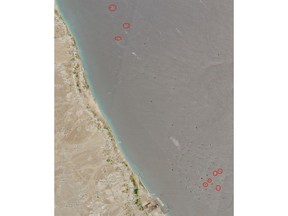
Satellite images showed vessels conducting cargo transfers outside of Hormuz, in an indication that some tankers are continuing to cross the waterway dark. A total of 12 such switches were seen along a stretch of water that spans more than 100 kilometers (62 miles) of the coasts of Oman and the United Arab Emirates on Monday, according to data from the European Union’s Sentinel 2 satellite.
Article content
Article content
Article content
At least four outbound supertankers carrying eight million barrels of crude reappeared after transiting Hormuz since Saturday, according to vessel-tracking data compiled by Bloomberg, as well as Kpler and Vortexa figures. Some of those vessels have historically engaged in shuttling, while others could sail on to refineries elsewhere in the world.
Article content
By signing up you consent to receive the above newsletter from Postmedia Network Inc.
Article content
The shuttling and transfers of barrels are providing a vital lifeline for global energy markets during the ongoing tensions in the region, and helping to restrain prices. At times, millions of barrels a day have been escaping through the waterway, easing the supply losses to global markets caused by the conflict.
Article content
It’s not without risk, though. The United Arab Emirates’ main oil company, among the most active in getting oil out through Hormuz during the war, said late last week that 15 of its ships had been attacked during the conflict. Another vessel was hit at the weekend, after that statement was published.
Article content
The shipping arm of state giant Abu Dhabi National Oil Co. said on Tuesday that it posted significantly higher earnings in the most recent quarter due to “additional services provided to deliver energy from the UAE to the world.” High freight rates also helped boost profits.
Article content
Article content
Many of the vessels escaping Hormuz are doing so using a route that hugs Oman’s coastline. Such ships are generally receiving assistance from the US military while they transit.
Article content
The status of Hormuz has been a sticking point in efforts to end the Iran war. Tehran has insisted it must have authority over which vessels pass through Hormuz, and wants to impose tolls. The US, meanwhile, has enforced a blockade on Iranian ships to disrupt flows.
Article content
The continued attacks on shipping mean that there’s still a relatively limited pool of shipowners willing to enter the Persian Gulf. The result has been a surge in oil tanker earnings, which are once again near $500,000 a day on the benchmark route.
Article content
—With assistance from Rakteem Katakey.
Article content
 English (US)